
Personal training vs group fitness.
If your goal is fast, safe, measurable progress, especially with strength training, 1-on-1 personal training wins on cost per minute of real attention. If your goal is cardio in a social setting, group fitness wins on energy and price-per-class. Most adults benefit from PT during the foundation phase, then layer in group classes once technique is solid. Below: a clean comparison, with citations.
- ✔ Personal training: 30 minutes of focused 1-on-1 attention, customized programming, every rep watched.
- ✔ Group fitness: 45 to 60 minutes, 1 instructor for 15 to 30 students, fixed class plan, social energy.
- ✔ Use PT to build the strength foundation. Add group classes for cardio and community once form is solid.
The two formats, compared.
| Dimension | 1-on-1 Personal Training | Group Fitness Class |
|---|---|---|
| Trainer ratio | 1 to 1 | 1 instructor to 15 to 30 students |
| Program personalization | Fully customized to your body and goals | Fixed class plan, same for everyone |
| Form correction | Every rep, in real time | Occasional, instructor-permitting |
| Session length | 30 to 60 minutes | 45 to 60 minutes |
| Social environment | Quiet, private | Energetic, social |
| Safety for beginners | High, supervised throughout | Lower, easy to learn bad form |
| Cost per session | $45 to $120 typical, $50 at E Studio | $15 to $35 drop-in, less with membership |
| Ideal for | Foundation phase, post-injury, specific goals | Cardio, social workouts, maintenance |
Pros
- Programming built around your body, history, and goals
- Form corrected every rep, very low injury risk
- Tracked, measurable progress on each exercise
- Standing appointment with a specific person, hard to skip
- Works around injuries, surgeries, and chronic issues
Cons
- Higher cost per session
- No group energy
- Quality varies by trainer, vetting matters
Pros
- Lower cost per class
- Social energy and community
- Wide variety of formats, cycle to bootcamp to dance
- Drop-in flexibility, fits most schedules
Cons
- Minimal individual attention or form correction
- One-size-fits-all programming
- Easier to coast or skip without anyone noticing
- Not ideal for clients with injuries or specific goals
Pick by phase, not forever.
The Mayo Clinic strength training guide emphasizes proper technique as the central safety variable. The Harvard Health resource on back pain notes that supervised exercise produces better outcomes than unsupervised work for clients with chronic issues. That is the case for personal training during a foundation phase.
Pick personal training if:
- You are starting strength training for the first time
- You are returning to exercise after an injury or long break
- You have specific goals: bone density, post-PT recovery, sport-specific
- You value time efficiency over social energy
Pick group fitness if:
- You already know how to move safely
- You want cardio and community at a lower price
- You enjoy variety and a class atmosphere
Fact-check it yourself.
- Mayo Clinic strength training guidelines
- Harvard Health on back pain
- PainScience: how often should you lift?
- NIH on exercise and bone health
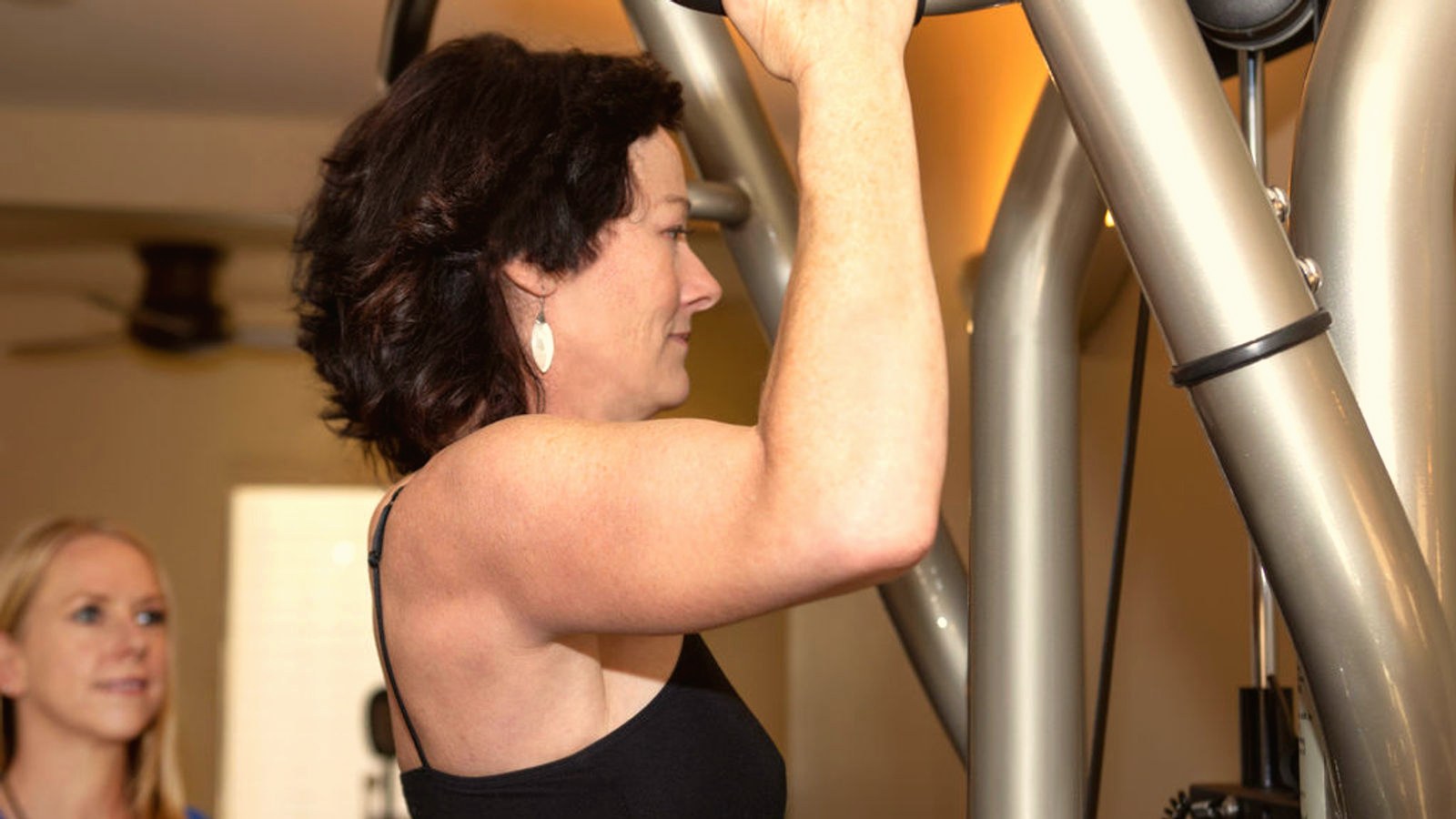
E Studio in downtown Santa Rosa has run 1-on-1 SuperSlow personal training since 2005. The studio caps four people on the floor at any time, including trainers, on Matrix and MedX machines. Bonnie Christopher founded the studio. Standing weekly appointments are the rule, not the exception.
Comparison FAQ.
If your question is not here, reach out, we answer every email personally.
Book your free session →Is personal training worth the cost?
Can I get the same results from a group class?
How is cost per minute of attention different?
What about accountability?
Can I do both?
If you're in Santa Rosa,
try the method once.
Thirty minutes on the floor at 621 Humboldt Street, downtown Santa Rosa. No card on file, no follow-up sequence, no obligation to book a second.
Book your free session →